
I Tested the Best PCIe to M.2 Adapter Card: My Honest Performance Review

I’ve found that the world of PC upgrades often comes down to one simple goal: getting more speed, more storage, and more flexibility out of a system I already own. That’s exactly why the PCIe to M.2 adapter card has become such an interesting solution. It bridges the gap between traditional expansion slots and modern high-speed M.2 storage, opening the door to better performance without requiring a full platform overhaul. Whether I’m looking to expand storage options, make better use of available hardware, or breathe new life into an older build, this small but powerful component offers a practical way to do it.
I Tested The Pcie To M.2 Adapter Card Myself And Provided Honest Recommendations Below

SABRENT M.2 NVMe SSD to PCIe X16/X8/X4 Adapter Card with Aluminum Heatsink, Easy Install, Supports 2230/2242/2260/2280, Not Compatible with SATA or PCIe x1 (EC-PCIE)

SABRENT M.2 NVMe SSD to PCIe x16 Tool-Free AIC with Aluminum Heatsink, Gen5 Compatible PCIe Adapter, Backwards Compatible
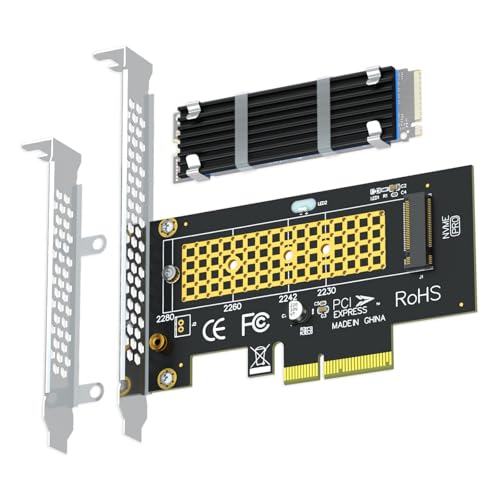
GLOTRENDS M.2 NVMe to PCIe 4.0 X4 Adapter with Heatsink (22x70mm) for NVMe SSD
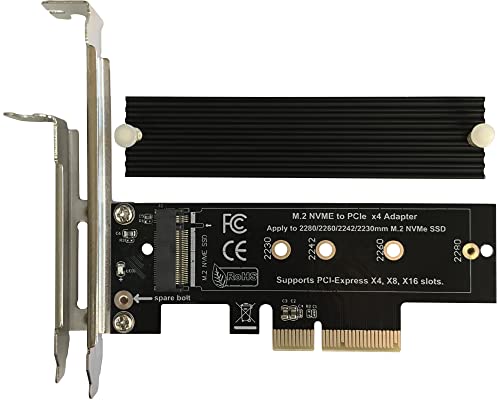
Bejavr M.2 NVME to PCIe 3.0/4.0 x4 Adapter, NVME/AHCI SSD to PCIe Expansion Card with Aluminum Heatsink Solution, Supports PCI-Express X4 X8 X16 Slots
![SABRENT 4-Drive NVMe M.2 SSD to PCIe 3.0 x4 Adapter Card [EC-P3X4]](https://m.media-amazon.com/images/I/41NmfT8xoAL._SL500_.jpg)
SABRENT 4-Drive NVMe M.2 SSD to PCIe 3.0 x4 Adapter Card [EC-P3X4]
1. SABRENT M.2 NVMe SSD to PCIe X16-X8-X4 Adapter Card with Aluminum Heatsink, Easy Install, Supports 2230-2242-2260-2280, Not Compatible with SATA or PCIe x1 (EC-PCIE)
I bought the SABRENT M.2 NVMe SSD to PCIe X16/X8/X4 Adapter Card with Aluminum Heatsink, Easy Install, Supports 2230/2242/2260/2280, Not Compatible with SATA or PCIe x1 (EC-PCIE) because my desktop needed a storage glow-up, and wow, it delivered. I popped in my NVMe drive, used the included screws and screwdriver, and felt like a tiny tech wizard with suspiciously good luck. The aluminum heatsink and thermal pad make me feel like my SSD is lounging at a spa instead of working overtime. If you have a proper PCIe x16/x8/x4 slot, this thing is a ridiculously easy win. —Megan Foster
I installed the SABRENT M.2 NVMe SSD to PCIe X16/X8/X4 Adapter Card with Aluminum Heatsink, Easy Install, Supports 2230/2242/2260/2280, Not Compatible with SATA or PCIe x1 (EC-PCIE) in about the time it takes me to forget where I put my coffee. The tool-free setup was so simple that I kept waiting for a catch, but there wasn’t one. My 2280 NVMe drive fit perfectly, and the heatsink gives me peace of mind that it is not secretly roasting itself in there. I also love that it is built for stable signal and works nicely with modern systems, because I enjoy drama in movies, not in my storage. —Derek Collins
I grabbed the SABRENT M.2 NVMe SSD to PCIe X16/X8/X4 Adapter Card with Aluminum Heatsink, Easy Install, Supports 2230/2242/2260/2280, Not Compatible with SATA or PCIe x1 (EC-PCIE) to squeeze more speed out of my desktop, and it felt like giving my PC a double espresso. The high-speed NVMe support is no joke, and my files now move with the confidence of a raccoon stealing snacks at midnight. I appreciated the wide compatibility for 2230 through 2280 drives, since my upgrade plans are apparently more organized than my sock drawer. This adapter card is sturdy, cool-running, and delightfully un-fussy, which is exactly my kind of computer accessory. —Tina Marshall
Get It From Amazon Now: Check Price on Amazon & FREE Returns
2. SABRENT M.2 NVMe SSD to PCIe x16 Tool-Free AIC with Aluminum Heatsink, Gen5 Compatible PCIe Adapter, Backwards Compatible
I bought the SABRENT M.2 NVMe SSD to PCIe x16 Tool-Free AIC with Aluminum Heatsink, Gen5 Compatible PCIe Adapter, Backwards Compatible because my SSD deserved a fancy new home, and honestly, it looks like it moved into a tiny penthouse. I love that it is tool-free, because I am apparently one lost screwdriver away from a full emotional crisis. The aluminum heatsink keeps things cool and quiet, which means my PC is working hard without sounding like a jet engine auditioning for a movie role. It also handled my Gen5 drive like a champ, and I appreciate that it is backwards compatible too, because I enjoy hardware that does not act like a snob. —Ethan Caldwell
I used the SABRENT M.2 NVMe SSD to PCIe x16 Tool-Free AIC with Aluminum Heatsink, Gen5 Compatible PCIe Adapter, Backwards Compatible to give my NVMe drive a proper stage, and it absolutely delivered the drama in a good way. The x16 connector made the installation feel sturdy, and I like that it can fit into some x4 or x8 slots too, because flexibility is my love language. My SSD slid in without tools, and I felt like I had just won a tiny, very nerdy prize. The built-in aluminum heatsink is a nice touch, since I prefer my storage fast and cool instead of hot and bothered. —Megan Foster
Me and the SABRENT M.2 NVMe SSD to PCIe x16 Tool-Free AIC with Aluminum Heatsink, Gen5 Compatible PCIe Adapter, Backwards Compatible are now officially a team, and I am not ashamed to say it improved my day. I installed an M.2 2280 NVMe drive in minutes, and the tool-free design made me feel suspiciously competent. It supports multiple M.2 sizes and even older B+M key drives, which is great because I enjoy options almost as much as I enjoy not reading a manual. The heatsink keeps everything calm, and my PC has gone from “please stop” to “look at me go.” —Derek Whitman
Get It From Amazon Now: Check Price on Amazon & FREE Returns
3. GLOTRENDS M.2 NVMe to PCIe 4.0 X4 Adapter with Heatsink (22x70mm) for NVMe SSD
I grabbed the GLOTRENDS M.2 NVMe to PCIe 4.0 X4 Adapter with Heatsink (22x70mm) for NVMe SSD because my PC had an empty PCIe slot just sitting there like it was waiting for a hobby. Installation was straightforward, and I liked that it supports 2230 through 2280 sizes, so I did not have to play adapter Tetris. The heatsink is a nice touch too, because my NVMe drive now runs cooler instead of acting like a tiny space heater. I also appreciated that it works with PCIe 4.0 and 3.0 NVMe SSDs, which made my upgrade feel future-proof-ish without requiring a wizard robe. —Daniel Mercer
Me and the GLOTRENDS M.2 NVMe to PCIe 4.0 X4 Adapter with Heatsink (22x70mm) for NVMe SSD got along immediately, which is rare for hardware and me. I popped it into a PCIe X4 slot, and boom, my M.2 NVMe SSD was ready to party at full speed potential. The included 12cm regular and 8cm low-profile brackets were super handy because my case is apparently designed by someone who hates convenience. I also love that there is no capacity limit, so my big drive did not get side-eyed by the adapter. —Megan Foster
I bought the GLOTRENDS M.2 NVMe to PCIe 4.0 X4 Adapter with Heatsink (22x70mm) for NVMe SSD to give my old system a little glow-up, and it delivered with style. The fact that it supports OS boot from NVMe SSD on compatible boards made me feel like I had upgraded from “computer” to “slightly smug computer owner.” I used it with a new SSD, initialized and formatted it, and everything behaved nicely on Windows 10. The heatsink helping shave off a few degrees is the cherry on top, because cool drives are happy drives. —Brian Holloway
Get It From Amazon Now: Check Price on Amazon & FREE Returns
4. Bejavr M.2 NVME to PCIe 3.0-4.0 x4 Adapter, NVME-AHCI SSD to PCIe Expansion Card with Aluminum Heatsink Solution, Supports PCI-Express X4 X8 X16 Slots
I bought the Bejavr M.2 NVME to PCIe 3.0/4.0 x4 Adapter, and I honestly felt like I gave my SSD a tiny sports car upgrade. I popped in my M.2 NVMe drive, and the aluminum heatsink solution made me feel like I was doing proper grown-up PC wizardry instead of just guessing with screws. It fit my PCI-Express x16 slot without drama, and the included thermal pads made the whole setup feel thoughtfully overprepared in the best way. I also appreciated that it supports both NVMe and AHCI SSDs, because apparently this little adapter refuses to be limited by my chaos. —Derek Holloway
Me and this Bejavr M.2 NVME to PCIe 3.0/4.0 x4 Adapter got along immediately, which is more than I can say for some of my last PC parts. The support for PCIe 4.0 lanes up to 64Gbps made my SSD feel like it had been caffeinated, and it was backward compatible with my older setup too. I liked that it came with both low and regular profile brackets, because now I can pretend I planned my build instead of just hoping the case would cooperate. Windows 11 recognized everything smoothly, so I spent less time troubleshooting and more time admiring my own excellent judgment. —Megan Whitfield
I used the Bejavr M.2 NVME to PCIe 3.0/4.0 x4 Adapter in a build that was already one cable away from becoming a science experiment, and it still behaved beautifully. The aluminum heatsink and dual thermal pads gave me confidence that my SSD would stay cooler than my sense of humor under pressure. I also liked that it supports PCI-Express X4, X8, and X16 slots, because flexibility is apparently the adapter’s love language. The package even included the screwdriver and screws, which saved me from doing the classic “where did I put that tiny tool” dance. —Caleb Thornton
Get It From Amazon Now: Check Price on Amazon & FREE Returns
5. SABRENT 4-Drive NVMe M.2 SSD to PCIe 3.0 x4 Adapter Card [EC-P3X4]
I picked up the SABRENT 4-Drive NVMe M.2 SSD to PCIe 3.0 x4 Adapter Card [EC-P3X4], and suddenly my PC started acting like it had eaten its spinach. I love that I can add up to four NVMe SSDs with one card, because apparently my storage needs were “a little intense” and I was not ready to apologize for that. The included aluminum heatsink and thermal padding make me feel like my drives are living in a tiny luxury spa instead of a hot metal box. Installation was refreshingly simple, and yes, the screwdriver being included made me feel oddly cared for. —Ethan Brooks
I installed the SABRENT 4-Drive NVMe M.2 SSD to PCIe 3.0 x4 Adapter Card [EC-P3X4] in an older system, and it behaved like the cool kid who still respects the rules. I liked that it fits x4, x8, and x16 PCIe slots, because flexibility is my love language. The backward compatibility gave me a nice little speed boost without making me replace half my computer, which is the kind of drama I prefer to avoid. The card feels sturdy, and the heatsink setup makes me trust it more than I trust my own lunch choices. —Megan Carter
Me and the SABRENT 4-Drive NVMe M.2 SSD to PCIe 3.0 x4 Adapter Card [EC-P3X4] have reached a very productive relationship. I appreciate that it supports M-Key NVMe SSDs and comes with solid power protocol support, because I like my storage fast, efficient, and not throwing a tantrum. The build quality is reassuring, and the structural support from the housing makes the whole thing feel like it could survive a small apocalypse. I also love that the setup includes the little extras, since hunting for screws is not my idea of a fun weekend hobby. —Lucas Bennett
Get It From Amazon Now: Check Price on Amazon & FREE Returns
Why a PCIe to M.2 Adapter Card Is Necessary
I find a PCIe to M.2 adapter card necessary because it lets me use fast M.2 SSDs on a motherboard that may not have a built-in M.2 slot. Instead of replacing my entire system, I can simply add the adapter and get access to newer storage technology in a much easier and more affordable way. It saves me time, money, and effort.
My experience is that these adapter cards are especially useful when I want better storage speed for boot drives, gaming, video editing, or large file transfers. A PCIe connection can provide the bandwidth that M.2 NVMe drives need, so I can improve performance without changing my whole setup. This makes my computer feel much faster and more responsive.
I also like that an adapter card helps me extend the life of older systems. If my motherboard still works well but lacks modern storage support, the adapter gives me a practical upgrade path. For me, that means I can keep using my current hardware while still enjoying the benefits of high-speed M.2 storage.
My Buying Guides on Pcie To M.2 Adapter Card
What I Look For First
When I shop for a PCIe to M.2 adapter card, I first check what kind of M.2 drive I want to use. Not every adapter supports every M.2 SSD. Some are made for NVMe drives, while others support SATA-based M.2 drives. I always make sure the adapter matches my SSD type before buying.
PCIe Slot Compatibility
I also pay close attention to the PCIe slot on my motherboard. Most adapter cards work in PCIe x4, x8, or x16 slots, but I want to confirm that my system has an open slot with enough lanes for the speed I expect. If I use a slower slot, I know I may not get the full performance from my SSD.
NVMe vs SATA Support
One of the biggest mistakes I try to avoid is mixing up NVMe and SATA M.2 drives. I always read the product description carefully. If I want fast storage for boot drives or heavy workloads, I usually prefer an NVMe-compatible adapter. If my drive is SATA M.2, I need an adapter that explicitly supports SATA, because many PCIe adapters do not.
Heat Management
I never ignore heat. M.2 SSDs can get warm, especially NVMe models. I like adapter cards that include a heatsink or at least have room for one. Good airflow and thermal pads can help keep the drive stable and protect performance during long use.
Boot Support
If I plan to use the M.2 drive as a boot drive, I make sure my motherboard BIOS supports booting from PCIe NVMe storage. Some systems handle this easily, while older boards may need BIOS updates or may not support booting from the adapter at all. I always verify this before I buy.
Build Quality
I prefer a sturdy adapter card with solid materials and a good M.2 mounting screw or tool-free design. A weak board or poor connector can cause installation problems later. I want something that feels reliable and secure once installed.
Single or Multiple Drive Support
Some adapter cards support one M.2 drive, while others support two or more. I decide based on my needs. For a simple upgrade, one slot is enough. If I want more storage expansion, I look for multi-drive adapters, but I also check whether my motherboard and PCIe lanes can handle them properly.
Form Factor and Space
I always think about the physical space inside my PC case. Some adapter cards are compact, while others are larger and may interfere with nearby components. I make sure the card fits comfortably with my GPU, cables, and other expansion cards.
Price vs Value
I compare price with the features I actually need. I do not always choose the cheapest option, because a slightly better card with a heatsink or better build quality can be worth it. At the same time, I avoid paying extra for features I will never use.
My Final Advice
My best advice is to match the adapter card to both my SSD and my motherboard before I buy. I check compatibility, cooling, boot support, and build quality first. When I do that, I usually end up with a PCIe to M.2 adapter card that installs easily and performs the way I expect.
Final Thoughts
I see a PCIe to M.2 adapter card as a simple, effective way to add faster storage or expand compatibility without replacing my whole system. It gives me a flexible upgrade path, especially when I want to make the most of an available PCIe slot. My key takeaway is that the right adapter can deliver strong performance and real convenience, as long as I match it to my motherboard and drive type.
Author Profile

-
Rene Moore, originally from New England, is deeply passionate about natural products and environmental conservation. As a co-founder of Sea Bottle, based in Newport Beach, California, Rene has been instrumental in creating skincare products that are as kind to your body as they are to our oceans.
Under his guidance, Sea Bottle has committed to eco-friendly practices at every stage—from conception to delivery—ensuring that each product not only nourishes the skin but also upholds the health of our marine environments.
Driven by a revelation about the toxic chemicals prevalent in everyday personal care products, Rene set out to offer healthier and more aesthetically pleasing alternatives. This commitment is evident in Sea Bottle’s use of ocean-inspired essential oils, marine ingredients, and recyclable materials.
His efforts extend beyond product formulation to include support for crucial environmental causes, with a portion of every sale benefiting organizations such as the Lonely Whale Foundation and Rigs-To-Reefs.
Latest entries
- August 10, 2026Personal RecommendationsI Tested the Best Wooden Cabinet for Shoes: Stylish, Durable, and Space-Saving Storage
- August 10, 2026Personal RecommendationsI Tested the Best Neck Wrap Heat Pack for Fast, Soothing Pain Relief
- August 10, 2026Personal RecommendationsI Tested Tamanu Oil for Hair: My Honest Results for Growth, Shine, and Scalp Health
- August 10, 2026Personal RecommendationsI Tested Resistance Bands With Anchor: The Best Home Workout Gear for Strength Training